Nothing here is built to keep your child playing.
Every other app has a reason to want another twenty minutes out of your child, and something clever built to get it. A coin. A streak. A creature that gets sad when they leave.
PebbleYard is a learning app for 5 to 11s. A short lesson, then a timed quiz or spelling set on it, marked on our server and kept as a record you can read.
Seven days of the whole product, and no card.
Six differences, all of them shipped
- 01
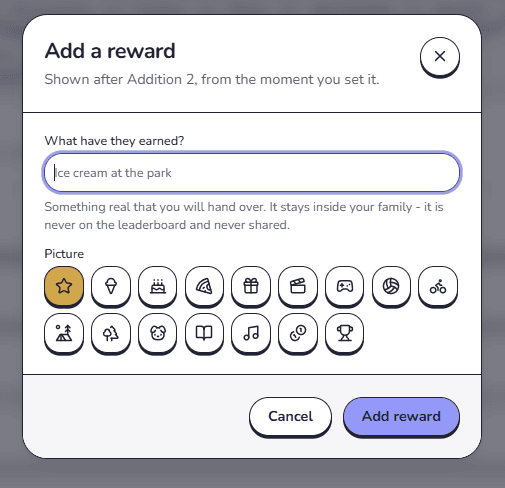
The reward is real, and you chose it
No coins, no shop. You promise something in the real world, and we tell you when it is earned.
- 02
Progress you read, not progress we assert
Marked on our server, written once, and not editable afterwards by anyone.
- 03
The catalogue is not the ceiling
Maths and English and plenty besides, plus whatever your child is obsessed with this month.
- 04
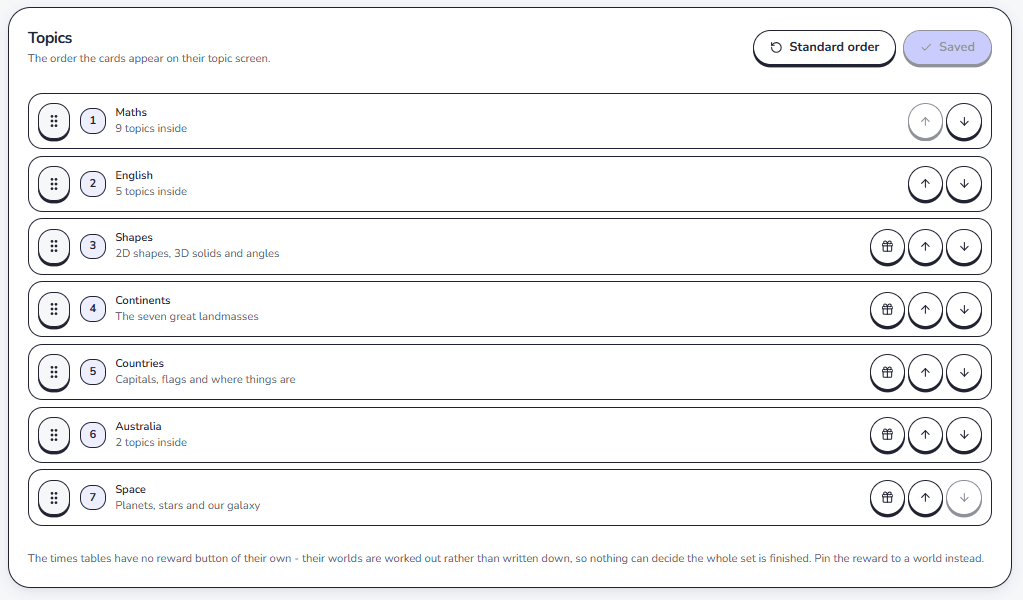
You set the order
Not a curriculum map. You decide what comes next, and the server holds you to it.
- 05
Your child has their own way in
Your family address and a PIN. No email, no account of their own, nothing to bill.
- 06
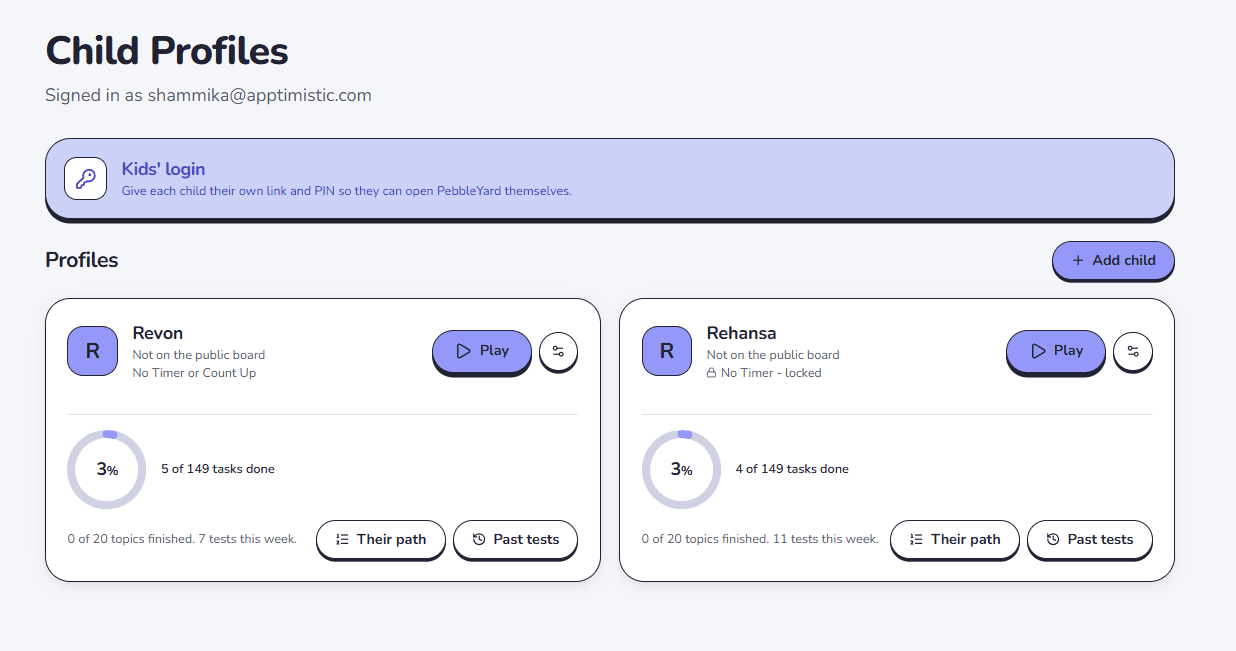
What is missing is the point
No ads, nothing to buy, no chat, and no streak to break.
50,000 gold coins, or an ice cream on Saturday?
A reward in the path
Ice cream at the park
Set by your grown-up, after the 7 times table
Ask a seven year old that and you already know the answer. So does the app that just gave them the coins.
Almost every children's app pays out in a currency it prints itself. Eggs, gems, coins, points, smart scores. Your child banks fifty thousand of them and there is exactly one thing they can be spent on: more of the app that issued them. A level. An outfit. A pet to feed tomorrow.
That is the design working, not a flaw in it. Time in the app is what renewal is measured against, so the currency has to be worth nothing outside it. A coin your child could spend somewhere else would end the session, and ending the session is the one thing an engagement mechanic cannot afford to do. It is a retention instrument with a bow on it, and the person paying the subscription is never told that is what they bought.
Look at who comes out ahead. Not the child, who has a pile of tokens that buy nothing they can eat, ride or keep. Not you, who now pays another month so a balance stays spendable, on an app whose pull on your child stopped being about learning anything a while ago. The scoreboard money is the product's own marketing budget, and your child is the one carrying it.
Progress you can read, not progress we assert
Four things are true of every attempt your child makes, and each is a property of how the app is built rather than a promise on a page.
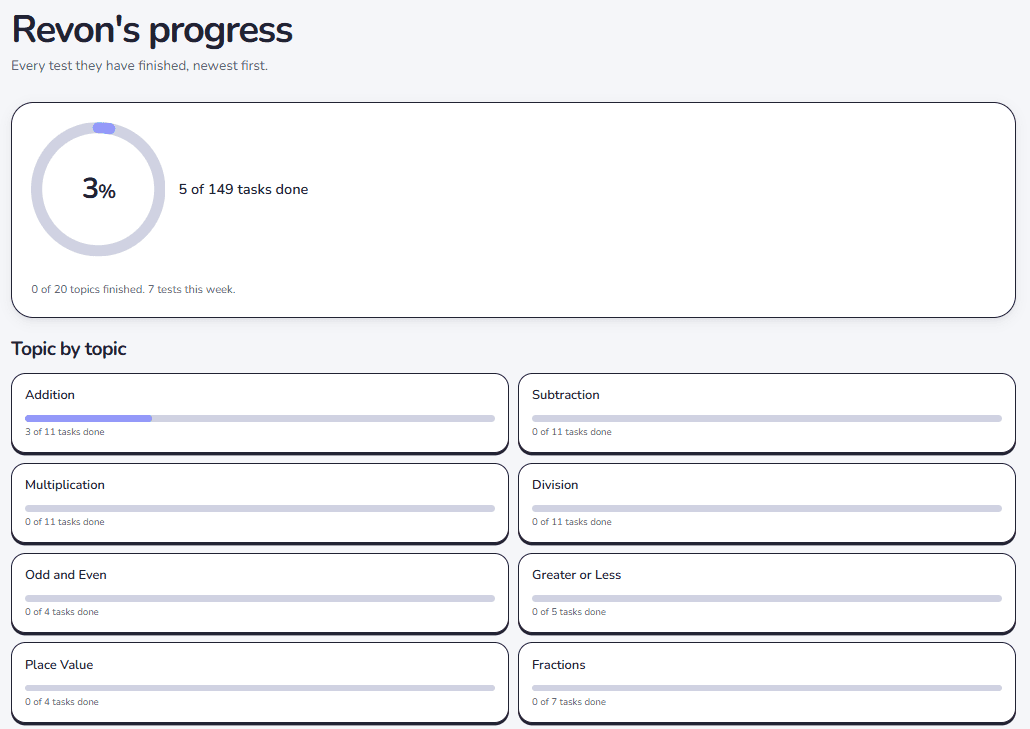
Marked on our server
The correct answer never reaches the browser, so there is nothing in the page to find.
Written once, never edited
A finished attempt has no edit path. Not for your child, not for you, not for us.
The board name is derived, not sent
The database decides the name on a public board, so nobody can appear as someone else.
Pausing removes the question
A paused test takes the question off the screen rather than covering it.
One exception, from us rather than found by you: drill topics that invent a fresh question each time, like times tables, are marked in the browser, because there is no stored answer to mark them against.
Maths and English are the floor, not the ceiling
A shared catalogue can only hold what every customer has in common, so everything interesting sits outside it. Geometry, continents, countries on a tappable map, space, states and towns and the AFL clubs are all in the box.
Then type a topic name and let our AI build the rest: lesson, quiz, spelling set, ready in minutes for you to review and tweak. Birds in the garden. Car badges. A topic your child chose gets three attempts. One you chose gets one.
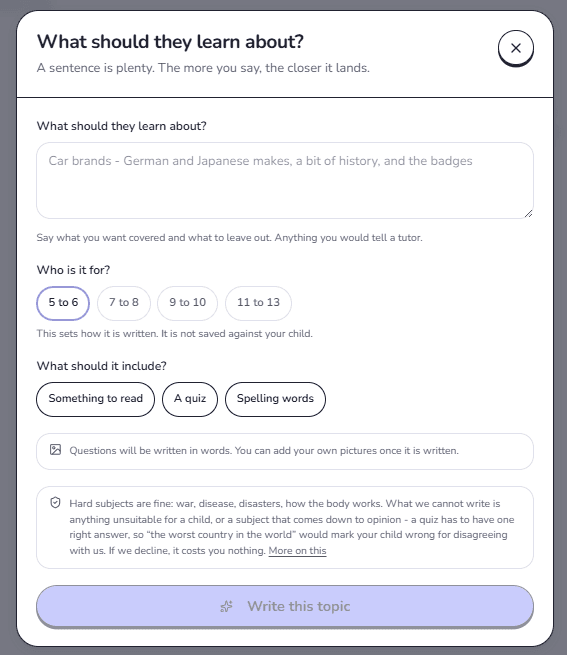
Why letting AI write topics is safe
You describe the topic, our AI writes it, and four checks run between those two steps, each refusing rather than guessing: your request before a word is written, the writing itself, the finished pack, and again if it changes before going live. All four run on our own key, so none of them can expire.
Being declined never costs you a topic, and what you describe stays private to your family. What we will and will not write.
Your sequence, not a curriculum map
You decide what your child works through and in what order, down to which times table comes first. A curriculum map is a real strength until the class is on the eight times table this week.
The order lives on our server, because a browser that states the order is a browser that unlocks things.
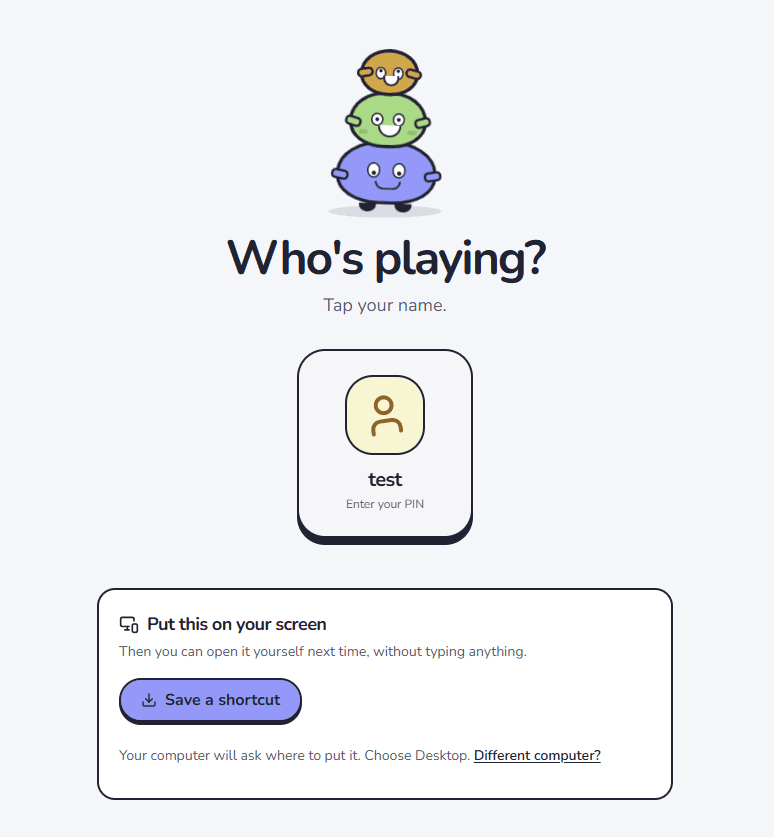
A door for your child, with nothing behind it to bill
They sign in at your family's own address with their own PIN and land on their hub. No billing, no settings, and they never need your device.
No email for them, no account of their own, and no seat on your plan.
What is missing is the point
Most apps can claim some of this list. Few can claim all of it, because a free product needs somewhere to sell you something and an engagement product needs a social loop.
No ads
Nobody is bidding for your child's attention here.
Nothing to buy inside
No currency, no shop, no upgrade prompt aimed at a seven year old.
No chat, no feed
No messaging, and no way for one child to reach another.
No streak to break
Miss a week and nothing is lost, because nothing was being held over them.
Aliases by default
Results stay private to your family, and a public board shows an alias.
No trackers on child screens
No advertising or analytics tags follow a child through the app.
Things you notice in the first ten minutes
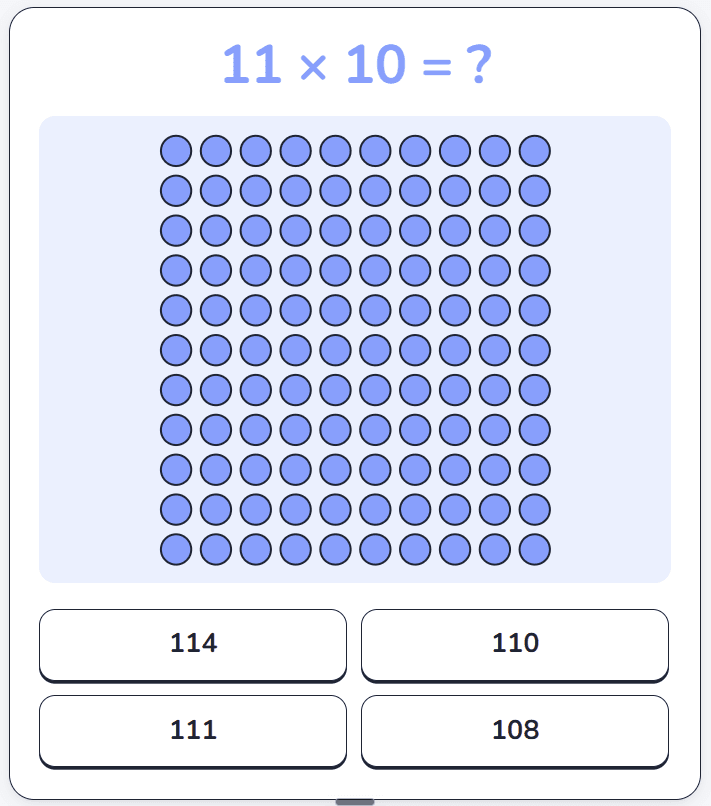
Multiplication has a shape
Eleven rows of ten, visibly a hundred and ten, before it is a fact to memorise.
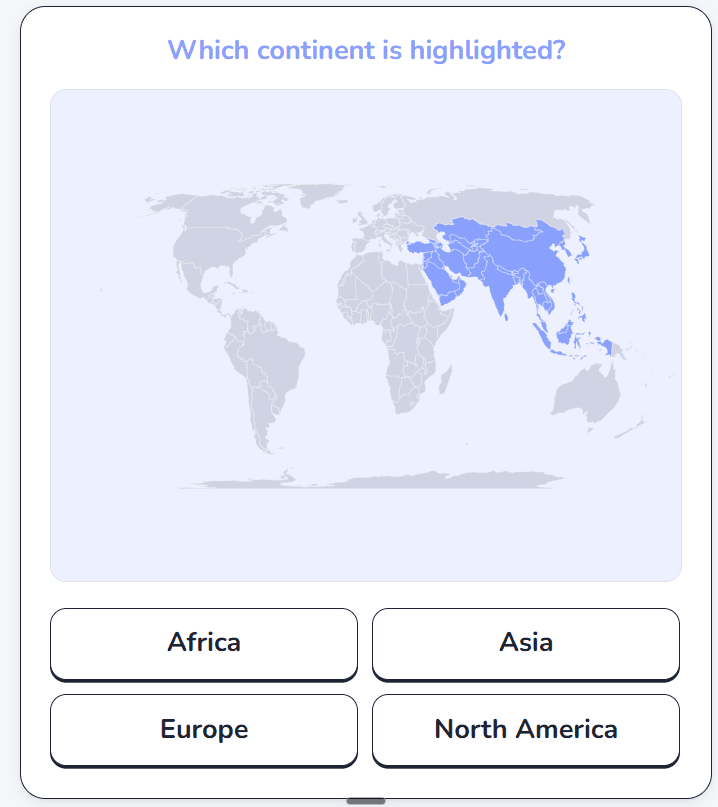
Maps you tap
Real countries to press, and map prompts you can use in your own topics.
Spelling on every topic
Built-in or your own. In most of the category that is a second app.
A timer you can lock
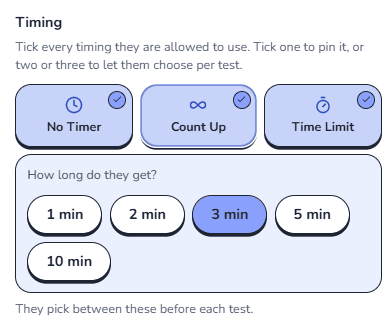
None, count up, or a hard limit only an adult can change.
Written where you live
Maths, not math. Australian states and AFL clubs, and 194 world capitals.
A different cost structure, not a discount
The category sits at ten to fifteen dollars a month. We are well under it because there is no game to build, no economy to balance forever, and nobody selling to you over the phone.
Cancel from settings with no retention call, and the price you join at is the one you keep.
Worth twenty minutes of a school's time
1000+ topics, Foundation/Prep to Year 6, sequenced to the Australian Curriculum Version 9.0 in Maths and English, with an ACARA reference on every topic. Staff can also author against the unit plan they are teaching, students sign in with a class code and a PIN or QR card, assessment settings lock, and the marking happens on our server so the score is one a teacher can use. We set the account up with you on a call, or you build your classes yourself in an afternoon.
Get in touchWe reply within one business day and set up a 20-minute call.
Sequenced to the Australian Curriculum v9.0
1000+ topics, Foundation/Prep to Year 6, in Maths and English, each topic carrying its own ACARA reference.
Classes, built in an afternoon
Paste a class list or upload a CSV. Every student gets a join code and a PIN or a printable QR card.
Describe it against your unit plan
Staff describe the lesson for the week they are teaching, and our AI writes it - quiz and spelling set included, ready to review before it goes live.
Your curriculum, brought in for free
Teach it your own way? We'll bring it into PebbleYard for you, free, with one account manager who sees it through - a founding-schools offer while we grow the catalogue.
Try it for a week
The whole product, no card, and the record of what your child did stays theirs either way.
Start free trialOr see it working first
How a session runs, step by step, for a family or for a centre.
What do other programs cost?
Plain guides to what other programs charge Australian families, with the sources and the date we checked each price.